Reducing vibrations on construction sites: practical guide to Directive 2002/44/EC
How to comply with Directive 2002/44/EC on hand-arm vibrations in construction: thresholds, exposure calculation, anti-fatigue solutions and compliant equipment.
Hand-arm vibrations are the second leading cause of occupational disease in construction, after musculoskeletal disorders. European Directive 2002/44/EC sets binding thresholds that every employer must respect.
This guide explains how to calculate your teams’ exposure and which solutions keep you in compliance.
Understanding Directive 2002/44/EC
The two thresholds to know
The directive sets two hand-arm vibration values, calculated over an 8-hour working day:
- Action value: 2.5 m/s²: the employer must implement a prevention programme (training, medical monitoring, seeking lower-vibration machines)
- Exposure limit: 5 m/s²: exposure must never exceed this threshold. Exceeding it constitutes a criminal offence.
Calculating daily exposure
Daily exposure A(8) is calculated as:
A(8) = a x sqrt(T / 8)
Where a is the machine’s vibration value (in m/s²) and T is the daily usage time (in hours).
Practical example: a standard grinder at 4 m/s² used 4 hours per day gives A(8) = 4 x sqrt(4/8) = 4 x 0.71 = 2.83 m/s². The action value is exceeded.
With a Sept Tools grinder at 0.35 m/s² used 8 hours: A(8) = 0.35 x sqrt(8/8) = 0.35 m/s². That is 7 times below the action value.
Consequences of excessive vibrations
For the operator
- White finger syndrome (Raynaud’s syndrome): vascular disorders in the fingers
- Carpal tunnel syndrome: median nerve compression at the wrist
- Early onset arthritis: accelerated wear of wrist and elbow joints
- Loss of grip strength: difficulty holding tools
For the employer
- Higher premiums: increased workers’ compensation contributions
- Absenteeism: extended sick leave (6 to 12 months for carpal tunnel)
- Criminal liability: in cases of inexcusable fault
- Recruitment difficulty: skilled operators avoid high-risk companies
Three levers for reduction
1. Choose low-vibration machines
The most effective lever. Brushless technology mechanically reduces vibrations by eliminating physical contact between rotor and stator. Sept Tools grinders deliver 0.35 m/s², compared to 3 to 8 m/s² for conventional brushed machines.
2. Use anti-fatigue accessories
Anti-fatigue accessories transfer the machine’s weight and vibrations to a mechanical support:
- Eland balancer: spring that compensates weight, vibrations absorbed by the articulated arm
- Mygale frame: wall-mounted structure that fully carries the machine
- Scourpio exoskeleton: wearable solution that redistributes loads
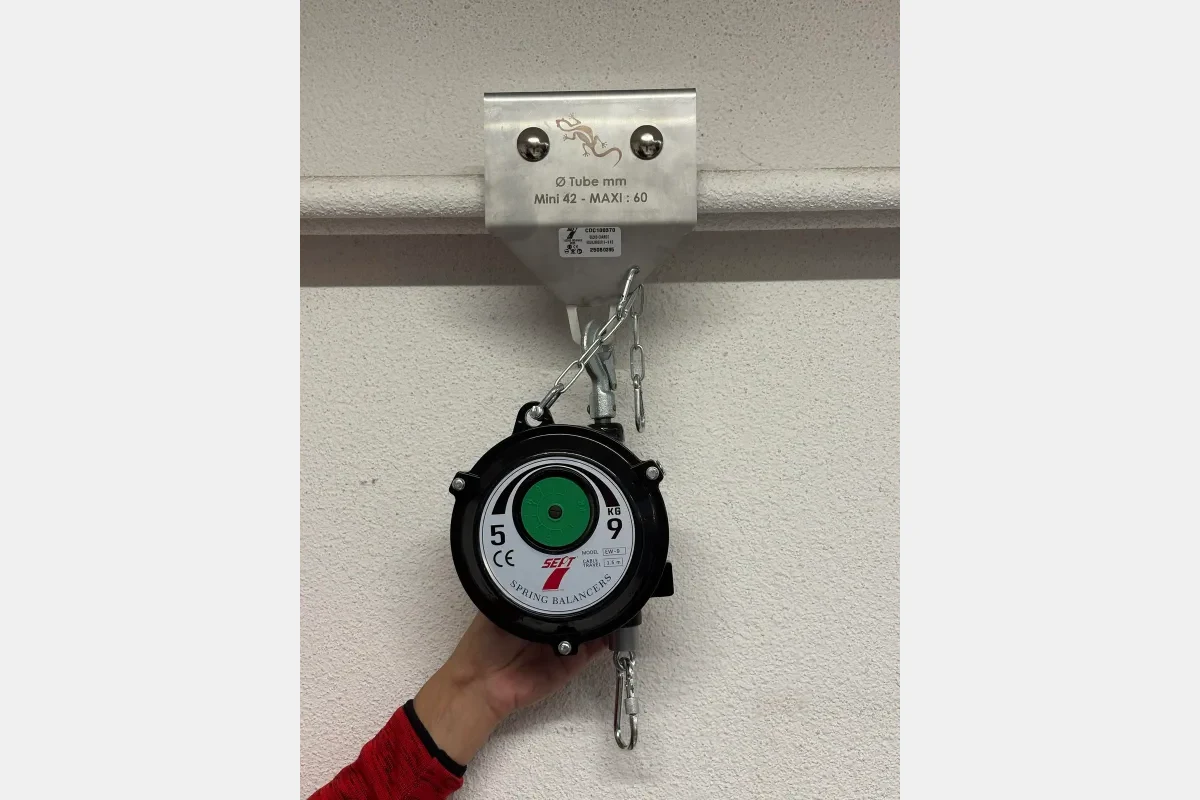
- Gecko balancer: compact suction-cup support for confined spaces
3. Organise job rotation
When source reduction is insufficient, job rotation limits each operator’s exposure time. Combine this with usage-time tracking per machine.
Compliance action plan
- Audit: record vibration values of all machines in the fleet
- Calculate: estimate A(8) for each workstation
- Replace: substitute machines exceeding 2.5 m/s² with brushless models
- Equip: install anti-fatigue solutions on the most exposed workstations
- Train: educate operators on best practices (grip, applied pressure)
- Monitor: implement enhanced medical monitoring and an exposure register
The Sept Tools solution
Sept Tools grinders combine three anti-vibration advantages:
- Brushless motor: 0.35 m/s² measured per EN 60745
- Anti-fatigue accessories: the machine’s weight no longer rests on the operator
- Integrated extraction: dust-free work reduces overall fatigue
Configure your anti-fatigue system or request a custom quote.
Sept Tools Configurator
Find your ideal set in 2 minutes
Guided questionnaire: grinder, vacuum and anti-fatigue accessories matched to your jobsite.
Free guide: 5 mistakes that shorten the life of your grinder
12 pages of practical tips for your job sites.
Frequently asked questions
What is the vibration threshold on construction sites?
How do I measure grinder vibrations?
Are anti-vibration gloves sufficient?
Which Sept Tools machines comply with the directive?
Find your ideal set
Configure your machine + ergonomics + vacuum combination in a few clicks.