Decorative concrete: grinding and professional finishes (polished, satin, raw)
Decorative concrete: grinding and professional finishes (polished, satin, raw). Technical guide to Mygale tools for architects and contractors.
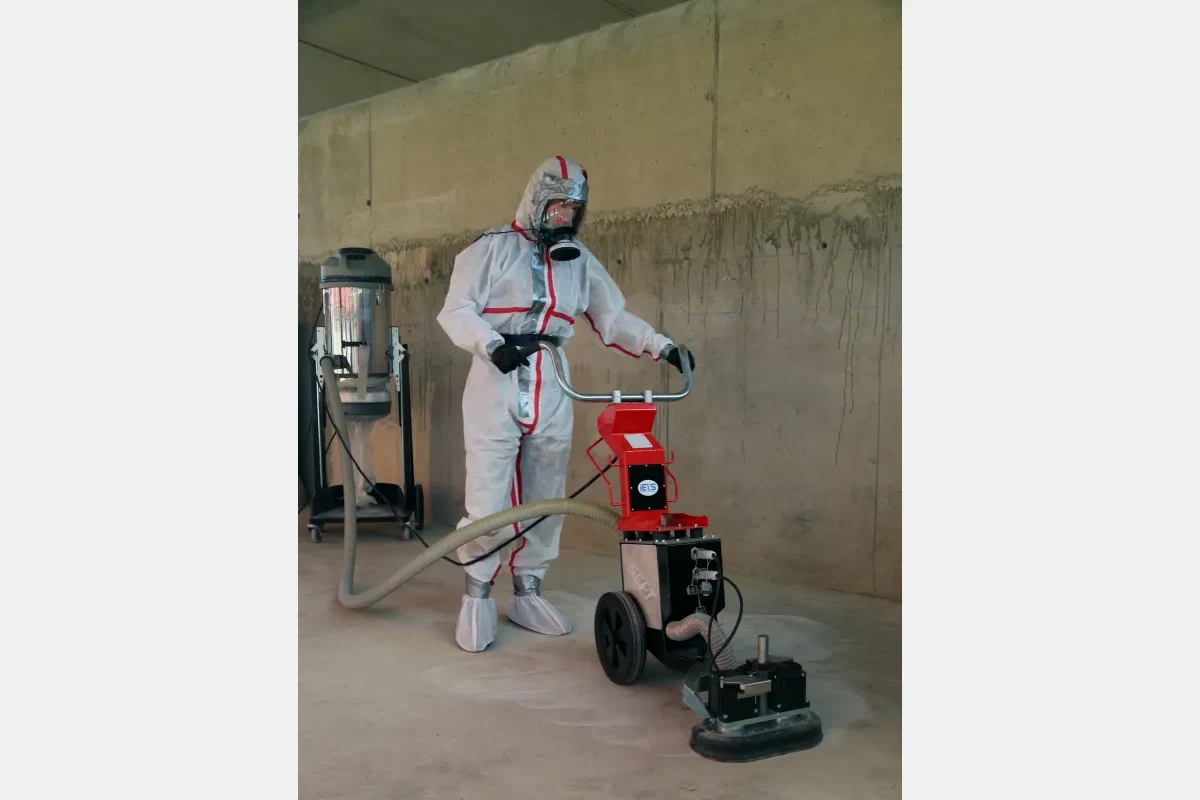
Raw, satin, polished, tadelakt
Full progression from roughing to mirror
The surface determines the finish result
Finish precision without operator fatigue
Decorative concrete transforms a raw material into a finished surface in its own right. Walls, ceilings, floors: the current architectural trend integrates exposed concrete as an aesthetic element in commercial, residential and public projects. For grinding professionals, this high-value market demands tooling capable of producing homogeneous, repeatable finishes that meet architects’ expectations.
Types of concrete finishes
Raw concrete (formwork concrete)
Raw concrete retains the marks of its formwork: board imprints, air bubbles, a slight laitance veil. The finish consists of homogenising the appearance without transforming it. A light grind at grit 60 to 120 is sufficient to remove surface laitance and even out the colour.
The appeal of raw concrete lies in its authenticity. The architect is looking for traces of the construction process. Grinding must be delicate: pressing too hard exposes the aggregates and destroys the intended effect.
Satin concrete
Satin offers a smooth feel and a matt to very slightly glossy appearance. It is the most requested finish for interior residential and commercial spaces. The abrasive progression runs from grit 60 to grit 400, with visual inspection between each pass.
Satin is less forgiving of irregularities than raw. Surface flatness and grinding consistency are critical. This is the finish where the difference between a suitable tool and a generic one is most visible.
Polished concrete (mirror)
Mirror polish is the most demanding finish. The surface reflects light like a mirror, revealing the slightest imperfection. The abrasive progression runs from grit 30 to grit 3000, in 8 to 10 successive passes.
Each pass removes the scratches from the previous one. Skipping a step (for example jumping from grit 200 to grit 800) leaves micro-scratches visible in the reflection. Progression discipline is absolute.
Tadelakt concrete
Tadelakt is a lime-based plastering technique applied over a concrete substrate, polished with a pebble and treated with black soap. Although it is a plaster rather than concrete grinding per se, the concrete substrate preparation is identical: the surface must be clean, rough (grit 30 to 60) and free of laitance to ensure plaster adhesion.
Grit and grinding progression
Fundamental principle
Grit size (abrasive grain size) determines surface roughness. A coarse grit (30) removes significant material and leaves deep scratches. A fine grit (3000) removes very little material and produces a mirror surface.
The golden rule: never skip more than a factor of 2 between successive grits. The recommended progression is:
Roughing: 30, 60 Refinement: 120, 200, 400 Polishing: 800, 1500, 3000
Choosing the first grit
The first grit depends on the initial surface condition:
- New formwork surface with laitance: start at grit 60
- Old surface with defects or excess material: start at grit 30
- Previously ground surface to rework: start at the grit just below the existing finish
Types of abrasives
Diamond: the most durable and precise. Essential for coarse grits (30 to 120) on hard concrete. Sept Tools diamond segments are designed for European concretes (strength 25 to 50 MPa).
Resin: used for fine grits (200 to 3000). Resin discs are more flexible and follow the micro-relief of the surface. They produce the final gloss.
The Mygale: the tool for decorative wall and ceiling concrete
Why the trolley changes everything
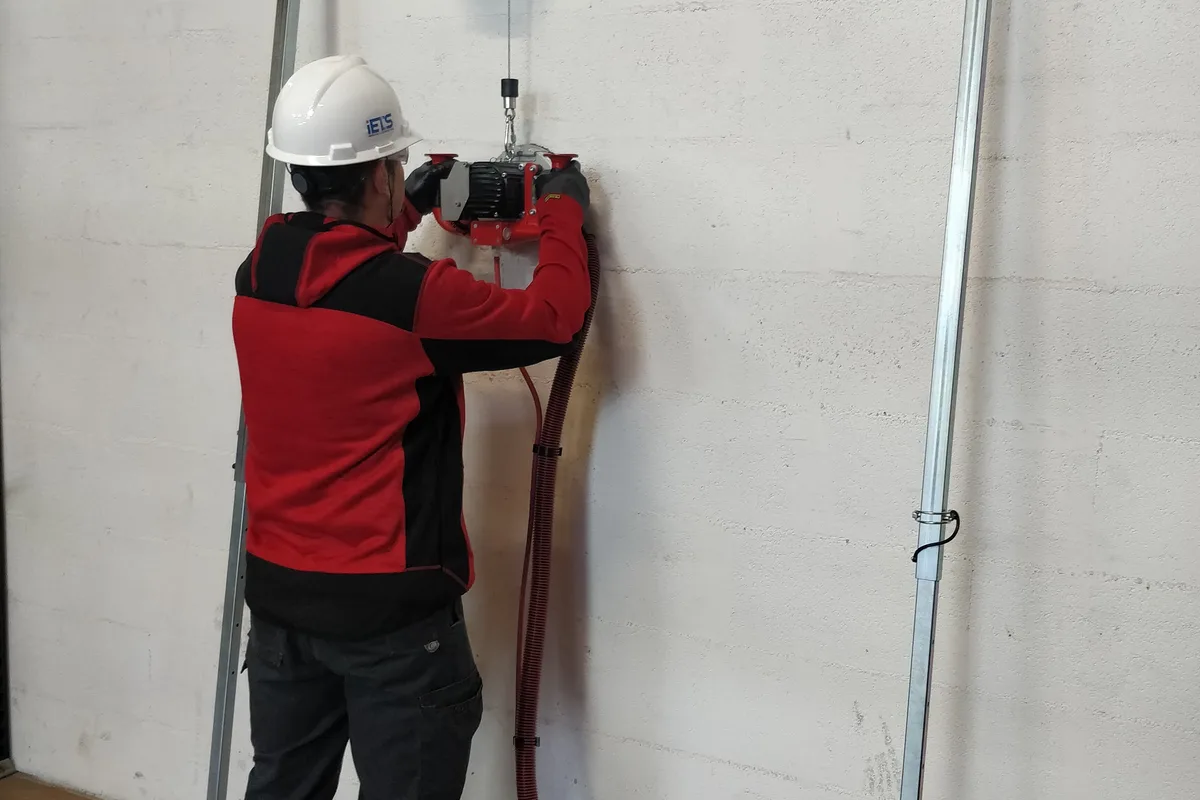
Decorative grinding on wall and ceiling presents a fundamental mechanical problem: the operator must maintain constant pressure while moving a 5 to 8 kg tool in an overhead or horizontal position. After 2 hours, fatigue alters pressure, which translates into visible finish variations.
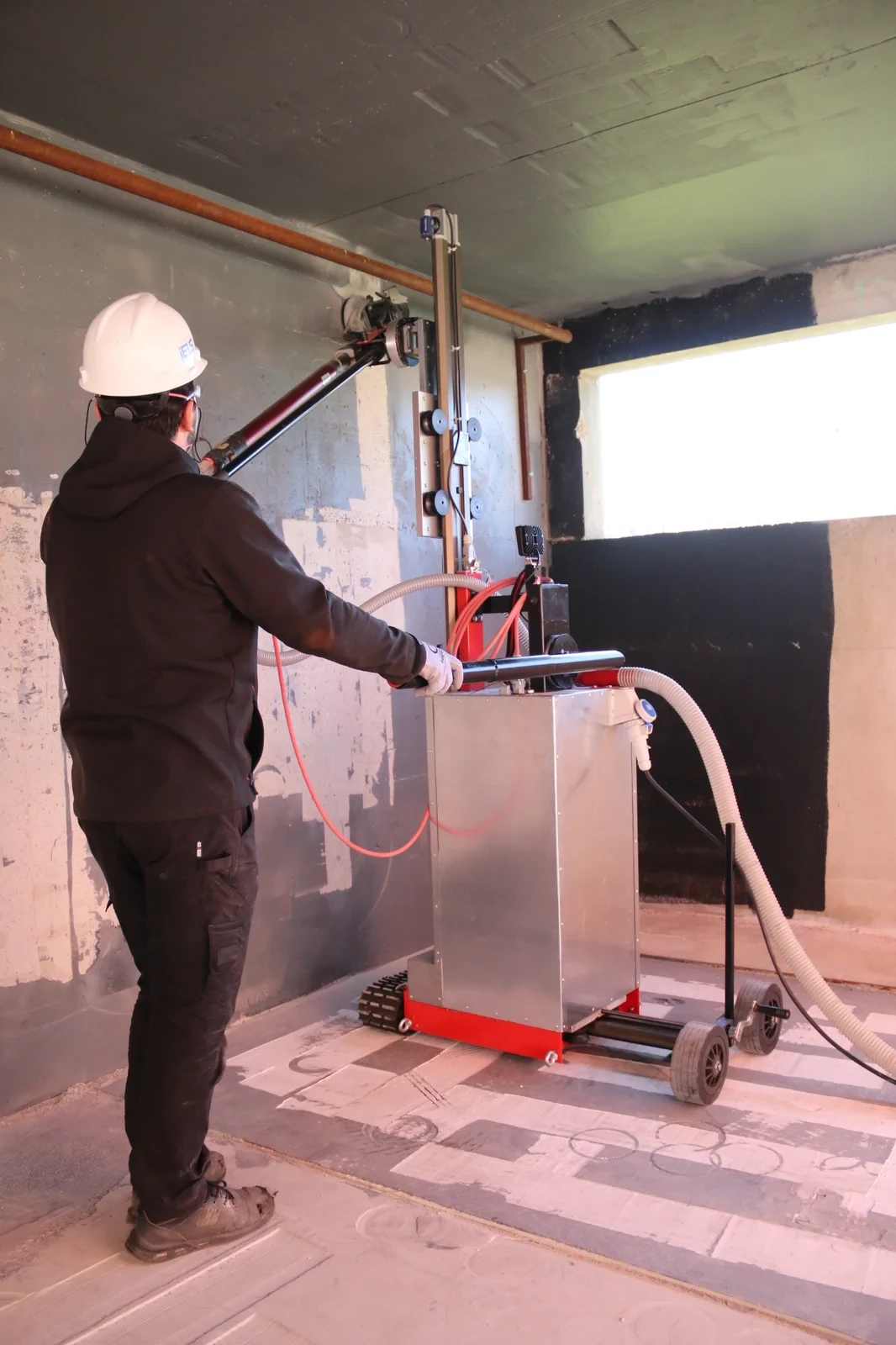
The Mygale trolley solves this problem with a counterbalance that compensates for the machine’s weight. The operator guides the movement without bearing the weight. Pressure is calibrated and constant from the first to the last square metre.
Technical specifications for tender documents
For architects and project managers writing specifications, here are the relevant technical specifications of the Mygale system:
- Motor power: 800 W, 1,200 W or 1,600 W depending on surface area and concrete hardness
- Vibrations: 0.35 m/s² at the handle (Directive 2002/44/EC compliant)
- Noise level: 60 dB(A) under load (Directive 2003/10/EC compliant)
- Pad diameter: 165 mm or 225 mm depending on configuration
- Sealing: IP65, compatible with integrated extraction
- Extraction: compatible with class M/H vacuum (IU33 Longopac recommended)
Variants by site type
New build, large volumes: Mygale 1600 W with 225 mm pad and IU33 Longopac vacuum. Maximum grinding throughput, continuous extraction eliminates emptying stops.
Renovation, restricted access: Petit Potam with 165 mm pad. The compact size enables work in corners and recesses inaccessible to the trolley.
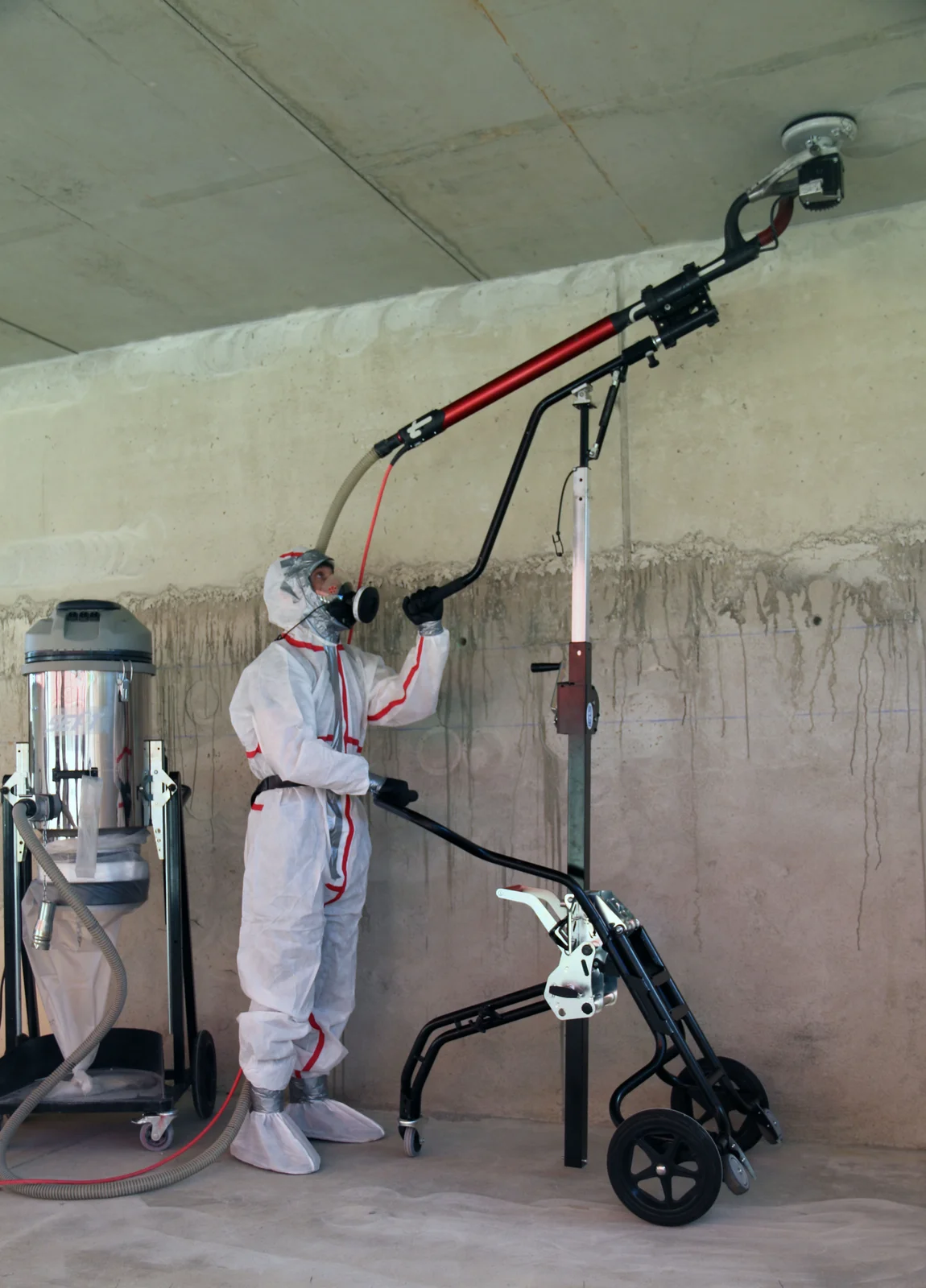
High ceilings (over 3 m): Fouine XB165 with telescopic extension. Reach extends to 4.5 m without scaffolding.
Surface preparation before staining or varnishing
Post-grinding cleaning
After the final grinding pass, the surface must be thoroughly dedusted. Concrete microparticles lodged in the pores can prevent surface treatment adhesion. A class M/H vacuum with appropriate extraction flow is essential.
Pre-treatment checks
Three checks before applying stain or varnish:
-
Absorption test: place a few drops of water on the surface. If the water is absorbed within 30 seconds, porosity is sufficient for treatment. If the water beads, the surface is too closed (grit too fine or contamination).
-
Raking light visual check: an LED lamp placed at 15 degrees to the surface reveals defects invisible under diffuse lighting. Residual scratches, overlaps and flatness variations appear clearly.
-
Moisture measurement: the concrete must be dry (residual moisture below 4%) before applying an impregnant or varnish. A pin or microwave moisture meter gives a reliable reading.
Quotation and site scheduling
Grinding time estimates
For medium-hardness concrete (30 to 40 MPa), grinding times per square metre are:
| Finish | Number of passes | Time per m² |
|---|---|---|
| Raw (grit 60-120) | 2 | 3 to 5 min |
| Satin (grit 60-400) | 4 | 8 to 12 min |
| Mirror polish (grit 30-3000) | 8-10 | 20 to 30 min |
These times include disc changes and intermediate checks. They are based on a suitable tool (Mygale or equivalent). With an unsuitable tool or manual grinding, multiply by 2 to 3.
Costing for tender documents
The cost of decorative grinding breaks down as:
- Labour: 60 to 70% of total cost
- Abrasive consumables: 20 to 25%
- Tool depreciation: 10 to 15%
On a 200 m² wall project in satin finish, allow 4 to 5 working days for one operator equipped with a Mygale trolley. The same project with a manual or unsuitable tool takes 10 to 15 days.
Architect approach: integrating decorative concrete into the project
Specifications for tender documents
Architects specifying decorative concrete should include in the technical specifications:
- The expected finish type (raw, satin, polished, with visual references)
- The final grinding grit
- Flatness tolerances (typically 2 mm under a 2 m straightedge)
- Expected gloss levels (measured by glossmeter, in GU)
- The surface treatment (impregnant, varnish, wax)
Samples and approval
Before starting grinding on the full surface, producing a 1 to 2 m² sample is essential. This sample must be approved by the architect before proceeding. It serves as the reference for acceptance inspection.
To size your decorative grinding tooling requirements, use the Sept Tools configurator or view the Mygale product page. For personalised advice, contact our team.
Sept Tools Configurator
Find your ideal set in 2 minutes
Guided questionnaire: grinder, vacuum and anti-fatigue accessories matched to your jobsite.
What operators face on site
Finish heterogeneity
Manual grinding or grinding with an unsuitable tool produces pressure variations that result in uneven gloss zones, unacceptable in decorative finishes.
The Mygale trolley maintains constant pressure via its counterbalance. The finish is homogeneous across the entire surface, from first to last square metre.
Overlap marks on large surfaces
On a wall over 10 m², overlaps between passes are visible in raking light. The end client or architect rejects the surface.
The Mygale trolley mechanics enable continuous, even movement that eliminates overlaps. The result is a perfect flat finish verifiable under raking light.
Fatigue and quality loss
Wall grinding in an overhead position is physically demanding. After 2 hours, the operator tires and quality drops.
The Mygale trolley counterbalance compensates for the machine weight. The operator guides without carrying, maintaining consistent quality throughout the full day.
The decorative concrete grinding process
Surface diagnosis
Hardness assessment (Schmidt hammer test), defect mapping, flatness measurement
Roughing
Grit 30 to 60, removal of excess material and surface defects
Intermediate grinding
Grit 120 to 400, progressive refinement, inspection between each pass
Final polishing
Grit 800 to 3000 depending on target finish (satin or mirror polish)
Protection
Application of an impregnant or varnish suited to the intended use
- 1
Surface diagnosis
Hardness assessment (Schmidt hammer test), defect mapping, flatness measurement
- 2
Roughing
Grit 30 to 60, removal of excess material and surface defects
- 3
Intermediate grinding
Grit 120 to 400, progressive refinement, inspection between each pass
- 4
Final polishing
Grit 800 to 3000 depending on target finish (satin or mirror polish)
- 5
Protection
Application of an impregnant or varnish suited to the intended use
Before / After Sept Tools
Manual or unsuitable machine grinding
- Uneven pressure, visible overlap marks
- Operator fatigue after 2 hours, degraded quality
- Vibrations 5 to 9 m/s², MSD risk
- Noise 90 dB(A), impossible in occupied buildings
- Uneven finish, rework required
Grinding with Sept Tools Mygale
- Constant pressure, zero overlap marks
- Full-day autonomy thanks to counterbalance
- Vibrations 0.35 m/s², zero MSD risk
- 60 dB(A), compatible with occupied buildings
- Homogeneous finish, deliverable in one pass
Equipment featured in this article
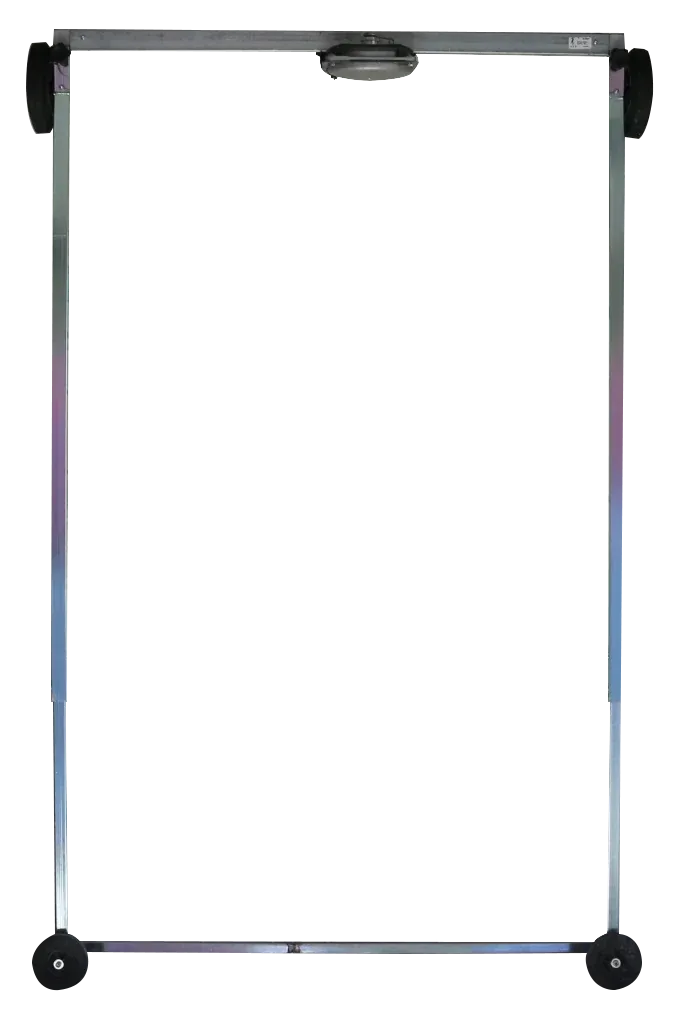
Mygale
Wall and ceiling grinding trolley, constant pressure for decorative finishes
View product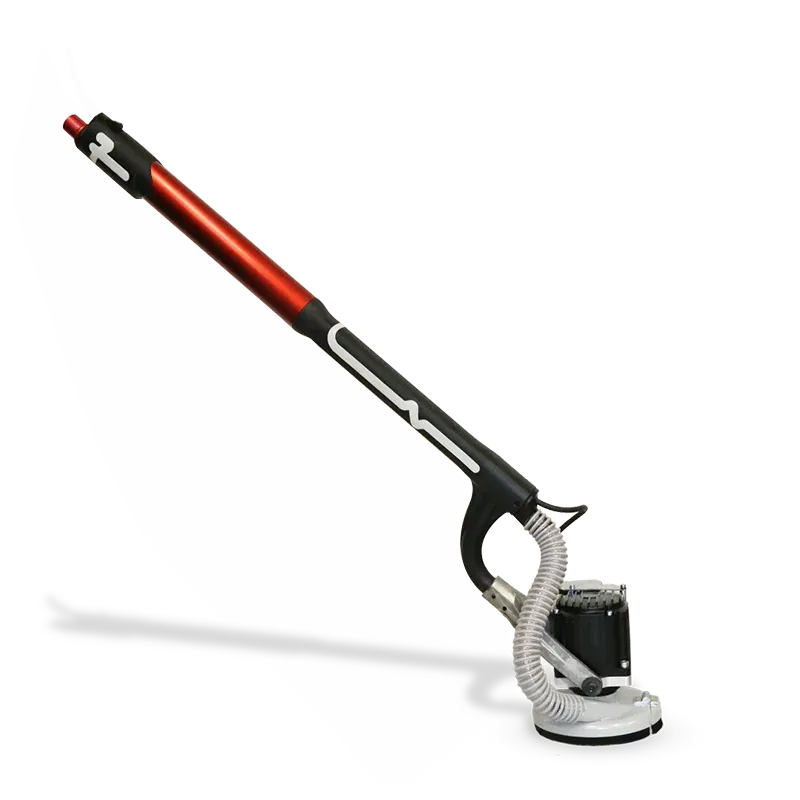
Fouine XB165
1600 W ceiling grinder, ideal for large concrete surfaces
View product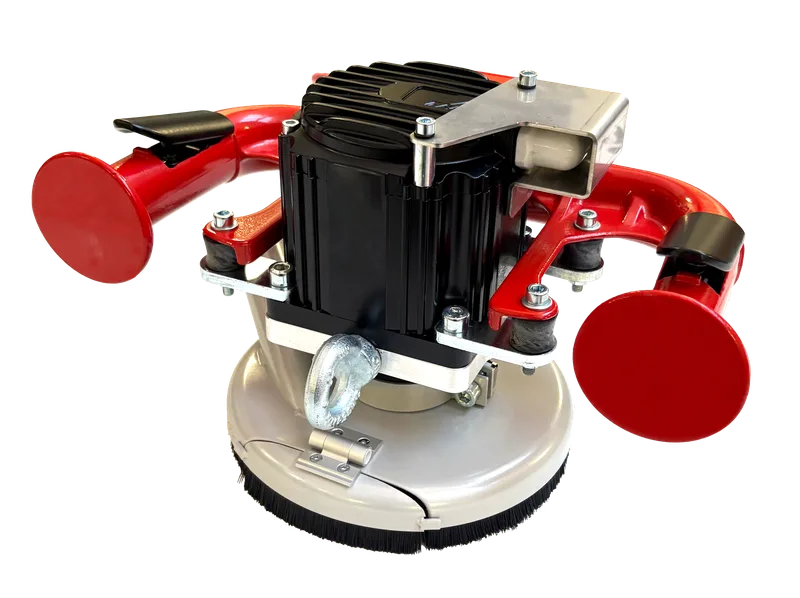
Petit Potam
Compact wall sander for restricted access areas
View product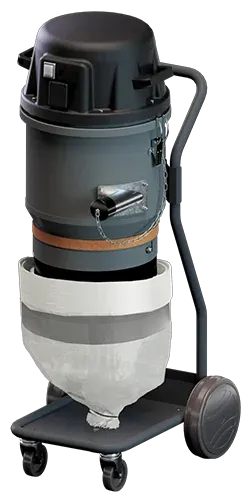
IU33 Longopac
Class M/H vacuum, concrete dust capture at source
View productFree guide: 5 mistakes that shorten the life of your sander
12 pages of practical tips for your job sites.
Frequently asked questions
What grit should I use for mirror-polished concrete?
Can you grind concrete less than 28 days old?
What is the difference between polished concrete and trowelled concrete?
Is the Mygale trolley suitable for decorative wall concrete?
Find your ideal set
Configure your machine + ergonomics + vacuum combination in a few clicks.