Concrete ceiling sander: Gazelle, Flex giraffe or Hilti DG 150?
On concrete overhead, three solutions meet: the Sept Tools Gazelle fitted with the Fouine XB165 (brushless giraffe in direct drive, on a rack-mast trolley), the Flex GM 340 trolley with its GDE 10 concrete giraffe (remote brushed motor and flexible drive shaft), and the hand-held Hilti DG 150 with its DPC 20 converter. This comparison places them side by side, criterion by criterion, on manufacturer data.
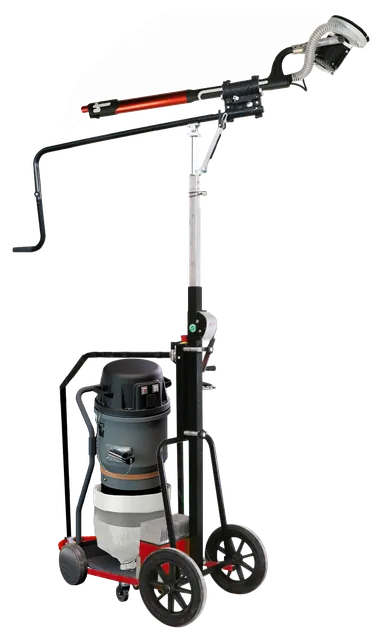
The three concrete solutions at a glance
Swipe the table to compare all 3 machines
| Criterion | Sept Tools Gazelle + Fouine XB165 | Flex GM 340 + GDE 10 giraffe | Hilti DG 150 + DPC 20 |
|---|---|---|---|
| Primary use | Brushless concrete giraffe on a machine-carrying trolley with rack mast | Diamond concrete giraffe on a GM 340 trolley | Hand-held diamond concrete grinder + converter |
| Target material | Concrete, laitance, coatings (diamond grinding) | Concrete, laitance (diamond grinding) | Concrete, screed, removal of thin coatings (max 3 mm) |
| Motor and drive | Brushless in DIRECT drive on the head: no carbon brushes, no drive shaft | REMOTE brushed motor + flexible drive shaft (Flex own term) | Powered by the mandatory external DPC 20 converter (cable-linked) |
| Rotation speed (rpm) | 500 to 4800, VARIABLE | 5800 to 8700 (diamond head) or 1700 to 2500 (pad head), variable | 4700 or 6600 (2 fixed speeds) |
| Motor power | 1600 W useful | 1010 W input / 590 W output | 2100 W input / 1500 W output (system) |
| Pad / disc | Diamond 165 mm | Diamond 150 mm | Diamond cup wheel 150 mm |
| Machine weight | 7.6 kg (Fouine XB165 head) | 3.6 kg (giraffe without grinding head) | 4.1 kg (+ 3.4 kg for the DPC 20 = 7.5 kg system) |
| Weight carried by the operator | Reduced: the Gazelle trolley carries the machine | Giraffe carried by its GM 340 trolley | 4.1 kg by hand, plus the DPC 20 box to drag on the floor |
| Working-height adjustment (trolley) | RACK mast: a hand crank, one-hand adjustment, precise | MANUAL mast: unscrew, lift the mast by hand, re-tighten to lock | Not applicable (hand-held machine) |
| Hand-arm vibration | 0.35 m/s² (reference machine benchmark) | Less than 2.5 m/s² | 5.8 m/s² |
| Noise level | 60 dB(A) (operator position) | 73.6 dB(A) pressure / 84.6 dB(A) power | 88 dB(A) pressure / 99 dB(A) power |
| Dust capture | Class H at source (IU33 Longopac extractor) | Ø28 mm connection (extractor class not specified) | Shroud + mandatory industrial extractor |
| External converter | IP65 electronic controller (no large box on the floor) | No external box: the speed-control electronics sit inside the machine body (variable-speed brushed motor) | DPC 20 mandatory, sits on the floor, cable-linked |
| Ingress protection | IP65 (water cleaning possible, no high pressure) | Not disclosed | Not disclosed (class II motor) |
| Motor lifespan | Up to 20,000 h (brushless, no carbon brushes) | Brushed motor: brushes to replace (wear part) | Not disclosed |
| Warranty | 24 months | Not disclosed (product page) | Not disclosed (product page) |
| Country of manufacture | Roanne, France | Chervon group (China), German-origin brand | Liechtenstein (Hilti brand) |
Competitor data from public manufacturer pages and documentation (sources at the bottom of the page). Sept Tools data from product sheets. "Not published" cells flag a figure the manufacturer does not disclose: it is not invented. The 60 dB(A) and 0.35 m/s² figures are positioning benchmarks measured on reference machines.
Direct drive or remote motor: what decides lifespan
This is the difference you do not see, and the one that decides lifespan. The Flex concrete giraffe (GDE 10, like the GE 5 R and GE 7) houses its motor in the body of the machine and drives the head through a flexible drive shaft, which Flex itself calls its "flexible drive shaft". That motor is a universal brushed motor, whose brushes are wear parts. The Sept Tools Fouine does the opposite: a brushless motor mounted in direct drive on the head, with no carbon brushes and no drive shaft. Two fewer wear points (the flexible shaft and the brushes), exactly where intensive concrete puts a machine to the test. This is also what underpins the brushless lifespan rated up to 20,000 hours.
Concrete or plasterboard: do not compare the GE 5 R to a concrete giraffe
Many prospects compare the Gazelle to the Flex GE 5 R because the trolley silhouette looks alike. That is a mix-up: the GE 5 R (500 W, 1100 to 1650 rpm, 225 mm hook-and-loop paper pad) is a drywall sander for plasterboard, filler and paint, and it does not grind concrete. The real Flex concrete giraffe is the GDE 10, with a 150 mm diamond disc, used here. On concrete, the honest comparison is therefore Gazelle + Fouine against GM 340 + GDE 10, and against the Hilti DG 150.
Height adjustment: crank versus manual mast
On a ceiling, you constantly adjust the working height. The Gazelle trolley has a rack mast: you turn a crank and set exactly the right height, one-handed, even mid-pass. The Flex GM 340 trolley has a manual mast: you unscrew, lift the mast by hand at arm length, then re-tighten to lock it. Over a day, that ergonomics gap counts as much as the specs. Its carrier can go electric with a tracked drive (Gazellomur).
Rotation speed: a variable range end to end
The Fouine runs from 500 to 4800 rpm in continuous variation, letting you modulate from finishing to heavy attack on a single machine. The Flex GDE 10 giraffe is variable but by tool range (1700 to 2500 rpm at the pad, 5800 to 8700 rpm at the diamond head). The Hilti DG 150 has only two fixed speeds (4700 and 6600 rpm). At a similar disc diameter (150 to 165 mm), it is the width of the adjustable range that sets the Fouine apart most, not the top speed. Crucially, the speed is adjustable across the whole range: you can work at low speed, on decorative concrete or controlled finishing, where a fixed-speed machine cannot slow down at all.
Footprint: with or without a converter on the floor
The Hilti DG 150 only works with its DPC 20 converter: the head weighs 4.1 kg, but you also drag along this 3.4 kg box placed on the floor and cable-linked, a 7.5 kg system. The Flex giraffe integrates its electronics. The Fouine uses an IP65 controller with no bulky box at the work position. On a ceiling, fewer cables and boxes on the floor means fewer obstacles.
Dust capture: silica and asbestos
Grinding concrete releases crystalline silica dust, so capture at source is essential. Sept Tools pairs its machines with a class H extractor (IU33 Longopac, HEPA H14 filtration, continuous sealed bagging): a UKAS-accredited laboratory measured 0.02 f/ml of asbestos fibres on an NHS hospital site with the Fouine XB165 and the IU33. The measurement concerns asbestos fibres, not silica. The Hilti DG 150 requires a shroud connected to an industrial extractor, the Flex giraffe a Ø28 mm connection. In all three cases, performance depends on the paired extractor.
What Flex and Hilti do very well
- +The Flex GDE 10 giraffe is light at the head (3.6 kg without the grinding head) and reaches very high speed at the diamond head (up to 8700 rpm), with a well-developed integrated speed control.
- +The Hilti DG 150 is a robust, well-documented diamond concrete grinder, backed by the Hilti service and rental network, effective for spot grinding and touch-ups.
- +For plasterboard and filler finishing, the Flex GE 5 R drywall giraffe stays lighter and well suited. On that ground, concrete is not the point.
Why concrete professionals choose the Gazelle
- 1.Brushless direct drive: no flexible drive shaft and no carbon brushes to replace, unlike the Flex giraffe. Fewer wear parts, a lifespan up to 20,000 h built for intensive concrete.
- 2.The Gazelle trolley carries the machine and adjusts with a crank (rack mast), where the Flex GM 340 imposes a manual mast to unscrew and re-tighten.
- 3.Connects to a class H extractor (IU33 Longopac); on an NHS hospital site, a UKAS laboratory measured 0.02 f/ml of asbestos fibres with the Fouine XB165 and the IU33.
- 4.IP65 controller with no bulky converter on the floor (unlike the Hilti DG 150 + DPC 20 pair), 60 dB(A), designed and assembled in Roanne with after-sales at the factory, 24-month warranty.
What customers ask before choosing
Is the Flex concrete giraffe really the same machine as the Fouine?
No, and the difference is in the drive. The Flex giraffe (GDE 10, like the GE 5 R and GE 7) has a remote brushed motor that drives the head through a flexible drive shaft, which Flex itself calls its flexible drive shaft. The Sept Tools Fouine has a brushless motor in direct drive on the head, with no carbon brushes and no drive shaft. The result: two fewer wear parts, and durability designed for intensive concrete where the Flex architecture is really at home on plasterboard and filler.
A warning: does the Flex GE 5 R grind concrete?
No. The Flex GE 5 R giraffe (500 W, 1100 to 1650 rpm, 225 mm hook-and-loop paper pad) is a drywall sander, for plasterboard, filler and paint. It does not grind concrete. The real Flex concrete giraffe is the GDE 10 (150 mm diamond disc), which is what this comparison places against the Gazelle. Many prospects compare the Gazelle to the GE 5 R because it is almost the same trolley: these are two different jobs.
What is the advantage of the Gazelle trolley over the Flex GM 340?
Working-height adjustment. On the Gazelle, the mast is a rack mast: you turn a crank and set exactly the right height, one-handed, even while working. On the Flex GM 340, the mast is manual: you unscrew, lift the mast by hand at arm length, then re-tighten to lock it. The Gazelle can go electric with a tracked drive (Gazellomur).
Do these machines need an external converter?
The Hilti DG 150 only works with its DPC 20 converter, a mandatory box placed on the floor and cable-linked: the head weighs 4.1 kg but the full system is 7.5 kg to move around. The Flex GDE 10 giraffe houses its speed-control electronics inside the machine body (a brushed motor can carry variable-speed electronics, these are two separate things). The Sept Tools Fouine uses an IP65 electronic controller, without a bulky box at the work position.
Do these machines protect against silica?
Capture at source is essential against silica dust. Sept Tools pairs its machines with a class H extractor (IU33 Longopac): a UKAS-accredited laboratory measured 0.02 f/ml of asbestos fibres on an NHS hospital site with the Fouine XB165 and the IU33. The measurement concerns asbestos fibres, not silica. The Hilti DG 150 requires a shroud connected to an industrial extractor, the Flex giraffe a Ø28 mm connection. In all three cases, the paired extractor determines the result.
See the Sept Tools machines compared here
A concrete ceiling to sand?
Tell us the surface and the material. We will propose the right Gazelle configuration, with no obligation.
Sources
Competitor manufacturer data consulted on 12 July 2026. Sept Tools data from the catalogue product sheets.
- Flex GDE 10 concrete giraffe (Set Turbo-Jet), specifications and "flexible drive shaft": flex-tools.com (1010 W, 150 mm disc, 5800 to 8700 rpm diamond head, flexible drive shaft).
- Flex GM 340 trolley (manual mast, compatible giraffes) and GE 5 R drywall giraffe (500 W, 1100 to 1650 rpm, 225 mm pad): flex-tools.com.
- Hilti DG 150 + DPC 20 converter, manufacturer manual: hilti.com (2100 W / 1500 W output, 150 mm disc, 4700 and 6600 rpm, vibration 5.8 m/s², 88 dB(A), weight 4.1 kg + DPC 20 3.4 kg).
- Sept Tools Gazelle, Fouine XB165, IU33 Longopac: product sheets on sept-tools.com.