Brushless technology, explained simply
No brushes and no commutator sparks: the technology of Sept Tools machines with a brushless motor.
The motor, part by part
Scroll: the motor comes apart part by part. Each one explains why it lasts.
Sealed housing
Sealed, fin-cooled
The electronics and windings are isolated from site dust, even during intensive concrete grinding.
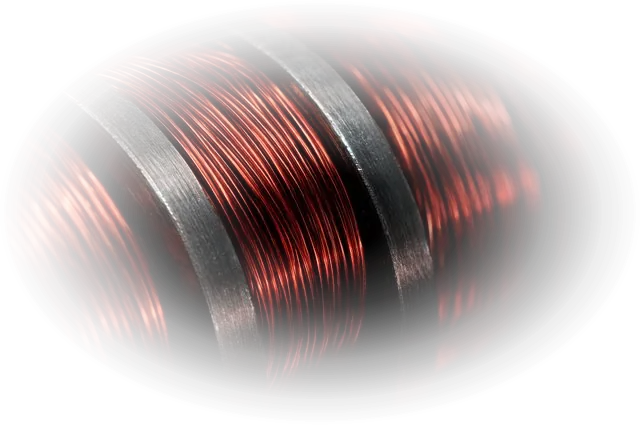
Copper stator
Power without friction
The magnetic field is switched electronically by the stator. No mechanical contact, no sparks, constant efficiency from the first job to the last.
Magnet rotor
Zero brushes, zero wear
No carbon brushes to replace: the wear part that limits the service life of a conventional motor. Sept Tools brushless has none, and the machine carries a 24-month warranty.
The motor, part by part
Scroll: the motor comes apart part by part. Each one explains why it lasts.
Sealed housing
Sealed, fin-cooled
The electronics and windings are isolated from site dust, even during intensive concrete grinding.
Keep scrolling to disassemble the motor.
Easier to live with on an occupied site. Declared in each grinder manual: Petit Potam 59, Fouine XB165 and Gazellomur 60, Tapir 64.
Less vibration in the hands, less strain. Highest declared value: 0.35 (K = 1.5), 0.27 for the Tapir. Reference: the daily action value is 2.5 m/s² A(8) (EU directive 2002/44/EC).
Dust-tight and protected against water jets: water cleaning possible, without high pressure.
20,000 hours for the brushless motor alone, versus about 1,500 hours for a brushed motor (motor-only basis).
Petit Potam and Fouine XB165: 500 to 4,800 rpm. Tapir: 470 to 4,800 rpm (manuals). Stripping to polishing on one machine.
Motor without brushes: the commutator and its sparks are gone.
Traditional brushed motor vs Sept Tools brushless
Traditional brushed motor
- Carbon brushes wear out and must be replaced
- Sparks at the commutator
- Motor life: about 1,500 h (motor alone)
Sept Tools brushless
- No carbon brushes to replace
- No commutator sparks
- Motor life: up to 20,000 h (motor alone, 13 times longer)
The brushless motor in 5 steps
No brushes, no carbons, no mechanical friction. Everything is driven by dedicated power electronics.
Permanent magnets
The rotor carries very high energy neodymium magnets, with no brushes (carbon brushes) and no commutator.
Position sensors
Position sensors read the rotor position in real time.
Electronic controller
The controller calculates the energising sequence of the stator windings based on the position read.
Electronic speed variation
The controller sets the rotation speed by potentiometer, within the range given in each grinder manual.
No brush friction
No mechanical contact between rotor and stator: nothing wears like a brush, and the motor lasts much longer.
- 1
Permanent magnets
The rotor carries very high energy neodymium magnets, with no brushes (carbon brushes) and no commutator.
- 2
Position sensors
Position sensors read the rotor position in real time.
- 3
Electronic controller
The controller calculates the energising sequence of the stator windings based on the position read.
- 4
Electronic speed variation
The controller sets the rotation speed by potentiometer, within the range given in each grinder manual.
- 5
No brush friction
No mechanical contact between rotor and stator: nothing wears like a brush, and the motor lasts much longer.
Experience the brushless difference
The best way to understand Sept Tools brushless is to hold one in your hand. Request a demo by video call or at our Roanne factory.
Vibration exposure simulator
EU directive 2002/44/EC sets two daily vibration exposure A(8) thresholds: the action value (2.5 m/s²) requiring preventive measures, and the limit value (5 m/s²) that must never be exceeded. Adjust your usage to compare.
A typical grinder or sander often sits between 4 and 8 m/s².
With a Sept Tools grinder declared at 0.35 m/s² (Petit Potam, Fouine XB165), A(8) is 0.35 m/s² over an 8 h day.
Request a quoteIndicative estimate based on ISO 5349. Real exposure depends on grip, surface and tool.