Public schemes and anti-strain construction tooling: 2026 overview
FIPU, Chemical risk, Asbestos, prevention contract: what the public schemes describe at 10/10/2026, conditions and documents to gather.
Single risk assessment document updated within the last year (companies with fewer than 11 employees exempt from the annual update)
A prevention contract in progress or obtained in the previous 2 years blocks the Prevention Subsidies
Vigilance certificate of less than 6 months at filing
Contract reserved for companies with fewer than 200 employees
A construction company manager who invests in anti-strain equipment quickly asks about public schemes. The subsidies of the Assurance Maladie, Risques professionnels (the French occupational risks insurance) work with equipment lists, and the right set-up consists of matching each line of the quote to the right scheme. This guide, up to date at 10/10/2026, describes what the official sources state, what is excluded and the documents to gather for each aid. It promises no funding: the conditions in force are those published on ameli.fr/entreprise and by your regional fund (Carsat, Cramif, CGSS), to be consulted before any purchase.
What has changed: why this guide was rewritten
Three structuring points, noted from the official sources on 10/10/2026:
- The Ergonomic Risk Prevention subsidy, financed by the FIPU (occupational wear prevention investment fund, Fonds d’investissement dans la prévention de l’usure professionnelle), is the central subsidy for anti-strain measures. Since 1 January 2026, applications relate to investments made and paid within the year. The equipment specification in force is annex 5, August 2026 version. Equipment ordered under the previous version (December 2025), and compliant with it, remains covered if the company can show an order dated before 1 October 2026 by a dated and signed purchase order (before 1 August 2026 for motorised wheels and food-trade display cases).
- The former TMS Pros Diagnostic and TMS Pros Action subsidies are no longer among the subsidies open to companies with 1 to 49 employees. TMS Pros is now a four-step support approach, intended for companies targeted by the Assurance Maladie because of their accident record.
- The Diesel fume capture subsidy is open to companies with 1 to 49 employees whatever their sector, but it funds systems for extracting exhaust gases and fumes, presented for garages and vehicle inspection centres: it does not cover jobsite tooling.
Above all, one rule runs through the ergonomic risks subsidy: the list of fundable equipment is strictly exhaustive. The ergonomic relevance of a piece of equipment is not enough, it must match a category of the specification. Outside this list, the Assurance Maladie describes two routes: the workstation adaptation component, on the written proposal of the occupational physician, and the prevention contract. This guide details them, because they directly concern grinding tooling.
Scheme 1: Ergonomic Risk Prevention subsidy (FIPU)
What is it?
It is the central scheme for anti-strain measures. Financed by the FIPU, it targets three risk factors: manual handling of loads, awkward postures, mechanical vibration. It is open to companies of the general social security scheme whatever their sector and size, as well as to self-employed workers with no employees who pay into the voluntary occupational accident insurance.
What are the amounts?
Values from the award conditions (August 2026 version), noted on 10/10/2026:
- Rate: 70% of investments excluding VAT
- Ceiling: 25,000 euros per type of expense (prevention, awareness-raising, workstation adaptation), with a maximum cumulative total of 75,000 euros over 2024-2027 for companies with 1 to 199 employees and self-employed workers, and of 25,000 euros from 200 employees
- Branch agreement: for companies covered by a branch agreement on ergonomic risks, 85%, 50,000 euros per type of expense and 125,000 euros cumulative under 200 employees; at 10/10/2026, no construction branch appears on the list published by ameli.fr
- Floor: 500 euros of subsidy, i.e. 715 euros excluding VAT of minimum investment
- Processing: in order of arrival, within the limit of available budgets
- Filing: online through the company account on net-entreprises.fr (section Votre entreprise > Demander une subvention)
For a given piece of equipment: fundable under conditions; check your eligibility with your regional fund before purchase.
How is the application made?
The official procedure runs in this order:
- Check before investing. The award conditions ask you to check, before making the investment, that it matches the conditions of the subsidy, and ameli.fr offers an eligibility simulator. The award conditions do not describe any fund agreement on the equipment before purchase: check your eligibility with your regional fund before purchase.
- Buy, have delivered and pay for the equipment within the calendar year.
- Submit the application on net-entreprises.fr, on a paid invoice, with the documents requested. Purchase and application must take place in the same calendar year.
- Receive the decision. After checking the documents supplied, the regional fund sends its decision within 2 months at most; ameli.fr indicates an average processing time of 23 days between the application and payment, as a guide.
Applications are processed in order of arrival, within the limit of budgets set by region and by headcount band: when they are exhausted, the application is no longer possible.
The key point: an exhaustive equipment list
The technical specification (annex 5, August 2026 version, available on ameli.fr) classifies equipment into five families: transfer equipment, rolling equipment, height-adjustable work surfaces, portable tools, seats and equipment limiting exposure to vibration, specific equipment.
For surface preparation tooling, you have to be precise, because the text is:
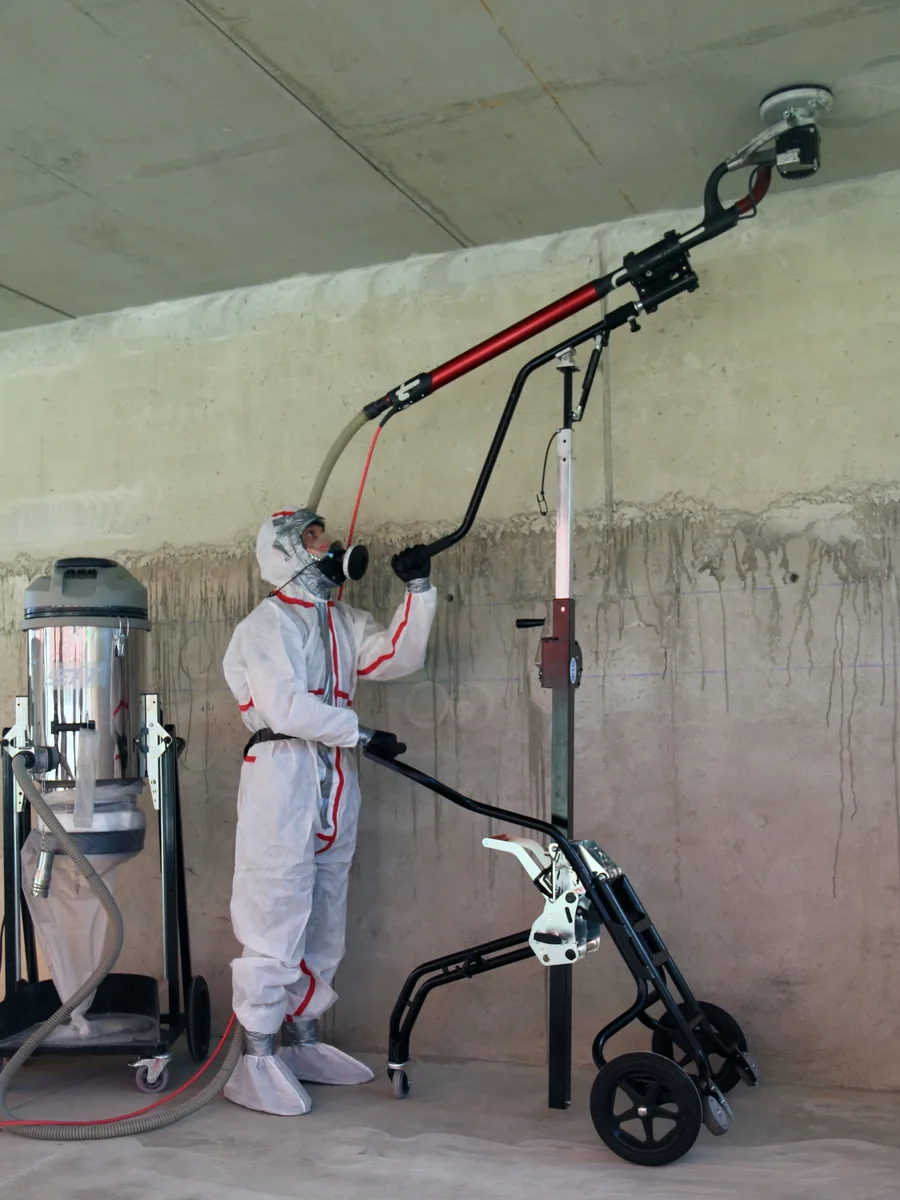
- Portable sanders and polishers: only non-eccentric orbital rotary machines and angle machines are retained, pneumatically powered, with a vibration value of 2.5 m/s² at most, measured and declared by the manufacturer. Excluded are vibrating, eccentric, belt and ‘vertical’ category sanders (giraffe sanders), as well as those whose manual does not declare a vibration value. Wall and ceiling sanders therefore do not appear in the list at present.
- Lifting appliances and handling aids: the specification retains notably motorised lifting appliances on fixed davits, fixed or mobile gantries with a maximum useful capacity of 2 tonnes or less, spreader beams and manipulators (vacuum tube lifters, load balancers, grippers). The requirements are precise: motorised winch or hoist for gantries, electric motorisation of the load lifting for spreader beams and manipulators. Excluded notably are the gantry, monorail or overhead crane on their own, as well as the davit or hoist on their own. A carrier falls under these categories only if it meets these requirements.
Practical consequence: on a ceiling or wall grinding set, the sander matches no category in the list, and the carrier falls into a category only if it meets its requirements, notably motorised lifting. For the machine, what remains is the workstation adaptation component on the occupational physician’s proposal (below) and the prevention contract (scheme 3). Fundable under conditions; check your eligibility with your regional fund before purchase.
Outside the list: what does the occupational physician’s proposal allow?
The Ergonomic Risk Prevention subsidy does not only fund equipment from the list. It includes a workstation adaptation component, as part of an approach to preventing occupational exclusion, whose costs may include the purchase of one or more pieces of equipment. This component has no equipment list: ameli.fr specifies that it is individual support, specific to an employee and recommended by the occupational physician.
The mechanism rests on two articles of the French Labour Code and one form:
- Article L. 4624-3: it allows the occupational physician to propose in writing individual measures to adapt, adjust or transform the workstation, after an exchange with the employee and the employer.
- The form known as annex 4: the certificate completed by the occupational physician, with its component for proposing individual measures. ameli.fr says it is mandatory; an ergonomic report cannot replace it.
- Article L. 4624-6: the employer must ‘take into consideration’ the occupational physician’s proposals and, if refusing them, give the reasons in writing to the employee and to the physician.
In practice, the sequence:
- The exposed employee (pain, restrictions, repeated work with raised arms) is seen by the physician of their occupational prevention and health service.
- The physician writes the written proposal for adapting the workstation (annex 4), precise enough for it to be possible to check that the equipment requested was indeed recommended.
- The company carries out the adaptation, buys and pays for the recommended equipment, then submits its application with the paid invoices, annex 4 and the certificate showing that the employee holds an exposed workstation (annex 3-5).
- The regional fund examines the application, within the ceilings of the scheme (25,000 euros for this component outside a branch agreement).
The limits to know: it is an individual measure, attached to an identified employee and workstation, with one complete file per employee concerned, and the purchase must match what the physician recommended. ameli.fr indicates that exoskeletons may be eligible for aid under this framework, when recommended by the occupational physician. A ceiling sander on a carrier, absent from the list, may fall under this component when it is the adaptation recommended for an exposed operator: fundable under conditions; check your eligibility with your regional fund before purchase.
Eligibility conditions
- Contribute to the general social security scheme as an employer and be up to date with contributions, notably occupational accidents and diseases (Urssaf vigilance certificate of less than 6 months); for a self-employed worker with no employees, belong to the voluntary occupational accident insurance at the time of purchase
- Single risk assessment document updated within the last year (companies with fewer than 11 employees are exempt from the annual update), kept available for the fund
- Not benefit from a prevention contract nor have benefited from one in the two years before the application
- Belong to an occupational prevention and health service, inform the staff representative bodies of the planned investments
- No injunction or additional contribution in progress for any of the establishments
- De minimis ceiling of 300,000 euros of public aid over the last three rolling years not reached
- Equipment new, owned by the company, not intended for rental (finance leasing, leasing and long-term rental excluded), delivered within the year
Official source
The ameli.fr portal, Entreprise area, Ergonomic Risk Prevention subsidy section (presentation of 15/01/2026, FAQ of 17/02/2026, branch agreements of 04/03/2026). The award conditions and the equipment specification (annex 5), both in the August 2026 version, can be downloaded there.
Scheme 2: the Prevention Subsidies open to companies with 1 to 49 employees
Reserved for companies with 1 to 49 employees, these national subsidies each cover an equipment list and share the basic conditions (single risk assessment document up to date, no prevention contract in progress or in the previous two years, de minimis ceiling). For Chemical risk equipment, High-vacuum network capture and Asbestos, two application modes exist: direct application, on invoices, after purchase; or reservation application, on a quote, which the fund confirms within 2 months at most before the purchase supporting documents are sent. In reservation application: fundable under conditions, prior validation by your regional fund before purchase.
Chemical risk equipment (70%)
Funds capture or exposure-reduction equipment: laboratory fume cupboards, ventilated safety cabinets, degreasing fountains, retention trays, misting devices for dust suppression and class L, M (or H) construction vacuums. Rate of 70% of the amount excluding VAT of the equipment and of the inspection, ceiling of 25,000 euros excluding VAT over the 2023-2028 period, minimum subsidy of 500 euros. Quotes, purchase orders and invoices must carry a statement of compliance with the specification, and an EC declaration of conformity is requested for all equipment except retention trays. It is the scheme to examine for a construction vacuum, subject to these documents.
High-vacuum network capture (70%)
A separate subsidy, for companies with 1 to 49 employees in all sectors, aimed at the inhalation of dust emitted by portable tools: collector network of ducts with connection points, extraction and dust-removal unit, portable machines fitted with capture devices and connectable to the centralised network, connectable cleaning tools. Rate of 70% of the amount excluding VAT of the equipment, the training and the inspection, same ceiling and minimum. A portable machine qualifies only with this centralised extraction network.
Asbestos subsidy (70%)
Four types of equipment: very high efficiency (THE) filter vacuum with safe bag-change system, mobile decontamination unit, device producing and distributing breathable air, full-face mask with air supply or assisted ventilation of the TM3P type. Rate of 70% of the amount excluding VAT, ceiling of 25,000 euros excluding VAT over 2023-2028. Quotes, purchase orders and invoices carry a statement of compliance with the specification, and the company’s asbestos officer must be trained. Exclusion to know: companies certified, or in the process of certification, for asbestos containment and removal (sub-section 3) are not eligible.
TOP BTP and the Falls Prevention subsidy
TOP BTP funds at 50% of the amount excluding VAT the equipment (standing or rolling MDS scaffolding approved to the NF mark, hatch protections, walkways, light shoring, jobsite huts, jobsite electrical cabinets) and at 70% the training. The Falls Prevention subsidy funds at 50% of the amount excluding VAT fall prevention equipment, including narrow micro mobile elevating work platforms and individual rolling platforms. Neither of these two lists includes portable power tools.
What no longer appears or does not concern the jobsite
- TMS Pros Diagnostic and TMS Pros Action: no longer among the subsidies open to companies with 1 to 49 employees. TMS Pros is now a four-step support approach for companies targeted by the Assurance Maladie because of their accident record; ameli.fr refers from there, under conditions, to the prevention contract or the ergonomic risks subsidy.
- Diesel fume capture: open to all sectors, it funds systems for extracting exhaust gases and fumes, presented for garages and vehicle inspection centres. It does not cover jobsite tooling.
Scheme 3: the prevention contract, the negotiated route
What is it?
It is the other official answer to the ‘relevant equipment but outside the list’ case, together with the workstation adaptation component of scheme 1. A national agreement on objectives (convention nationale d’objectifs) is an agreement signed for 4 years between the Assurance Maladie, Risques professionnels and the professional organisations of a sector. Within this framework, a company with fewer than 200 employees can draw up a prevention contract with its regional fund (Carsat, Cramif or CGSS). For construction, the table of agreements published on ameli.fr lists notably B020 ‘Building Activities’ and B021 ‘Public Works Activities’, both until 14/06/2027; the Public Works agreement, in force since 15 June 2023, provides for contracts of a maximum period of three years.
What the contract contains
Drawn up with the regional fund on the basis of a risk diagnosis of the company, the contract specifies the initial situation, the objectives, the action programme, the investments to be made, the deadlines, the amount of the fund’s aid and the conditions for paying advances. It is signed after consultation of the works council (CSE) or staff delegates and information of the DREETS and of the occupational risks directorate of the Cnam.
The rules to know
- The advance paid by the fund is converted into a subsidy if the company keeps all its commitments
- Access conditions: fall within the scope of a national agreement on objectives, have a headcount below 200 employees, be up to date with social obligations, including Urssaf contributions, and have a concrete prevention project
- Accumulation lock: a prevention contract in progress, or one the company benefited from in the two years before its application, blocks access to the Prevention Subsidies, including the ergonomic risks subsidy; the order of the steps is chosen with the fund
- For the prevention contract, the investments are entered in the contract drawn up with the fund: fundable under conditions, prior validation by your regional fund before purchase
Official source
The prevention department of your regional fund, and the ‘Contrats de prévention’ page of ameli.fr (13/10/2025).
Scheme 4: OPPBTP, support in building the file
A useful clarification, because confusion is frequent: the subsidy applications described in this guide are submitted to the Assurance Maladie, Risques professionnels and processed by the regional funds. The OPPBTP, the construction industry’s occupational prevention body, offers companies support in building their subsidy file and organising MSD prevention actions. A useful reflex: ask the OPPBTP to make the file more reliable, then submit it to the fund.
Scheme 5: Ademe, to be consulted before any filing
The Ademe aids for companies are published on the agency’s official portal (agirpourlatransition.ademe.fr). Before building a file for a tool or a construction vacuum, check on this portal that the targeted scheme does cover this type of equipment.
Scheme 6: CIR, CII and tax credits
They concern the company that carries out research or innovation (design office, prototyping), not the buyer of standard tooling. According to impots.gouv.fr, the CIR (research tax credit) equals 30% of research expenditure up to 100 million euros, and the CII (innovation tax credit), extended to 31 December 2027, equals 20% of eligible expenditure, within the limit of 400,000 euros per year (increased rates in Corsica and overseas territories).
Which counter for which Sept Tools equipment?
| Equipment | Ergonomic risks (FIPU), list | Chemical risk equipment, High-vacuum capture, Asbestos | Prevention contract |
|---|---|---|---|
| Carriers and gantries (Mygale, Gazelle, Eland, balancers) | Not at present (the specification requires motorised lifting) | Not listed | Investments to be defined with the fund |
| Brushless ceiling or wall sander | No (‘vertical’ category excluded, pneumatic power required) | Not listed | Investments to be defined with the fund |
| Class H vacuum | Not listed | Category listed (class L, M or H construction vacuum); quotes and invoices stating compliance with the specification required | Investments to be defined with the fund |
| THE vacuum with safe bag change | Not listed | Category listed (Asbestos subsidy, companies certified for sub-section 3 excluded); quotes and invoices stating compliance with the specification required | Investments to be defined with the fund |
| Scourpio exoskeleton | Not listed (workstation adaptation possible on the occupational physician’s recommendation) | Not listed | Investments to be defined with the fund |
| Brushless planer and bush hammer | Not listed at present | Not listed | Investments to be defined with the fund |
Key: ‘Not listed’ means that the equipment matches no category of the lists re-read on 10/10/2026. ‘Category listed’ means that the category exists in the list; the compliance of the appliance with the specification remains to be established, and Sept Tools technical documents do not amount to a statement of compliance. For the prevention contract, the investments are entered in the contract drawn up with the regional fund. For any equipment in the table, there is also the route of workstation adaptation on the occupational physician’s written proposal (scheme 1), which depends on a documented individual exposure and not on the list. In all cases, check your eligibility with your regional fund before purchase.
What data to gather, aid by aid?
A file stands on the documents it contains. Here, for each scheme, are the documents requested and the useful data.
For the ergonomic risks subsidy (FIPU)
Documents requested on net-entreprises.fr: completed online form (it serves as a sworn statement of the eligibility criteria; the single risk assessment document is kept available for the fund), Urssaf vigilance certificate of less than 6 months, de minimis sworn declaration, bank details (RIB), paid invoice showing the delivery date, the model and the serial number of the equipment, and certificate completed by the supplier on compliance with the specification (annex 3-3). This certificate binds whoever completes it and assumes that the equipment meets the specification.
Useful data: single risk assessment document stating in figures the targeted risks (workstations concerned, masses handled, durations with raised arms), vibration exposure values of current tools, AT/MP accident record, and quote whose designations match the categories of the specification.
For the workstation adaptation component (occupational physician)
Documents: paid invoices with the date of completion or delivery, certificate completed by the occupational physician (form known as annex 4, with its component for proposing individual workstation adaptation measures), certificate showing that the employee holds an exposed workstation (annex 3-5) and the usual administrative documents. One complete file per employee concerned.
Useful data: a proposal that describes precisely the workstation, the exposure and the adaptation expected, precise enough to check that the equipment requested was recommended, and consistency between the proposal, the single risk assessment document and the invoice. Sequence: visit to the occupational prevention and health service, written proposal from the physician, purchase, then application.
For the Chemical risk equipment, High-vacuum network capture and Asbestos subsidies
Same administrative documents, plus: quotes, purchase orders and invoices carrying a statement of compliance with the specification, EC declarations of conformity, employer’s sworn statement on information about the risks and training in the use of the equipment and, for Asbestos, the asbestos risk training certificate of the company’s officer. Two application modes: direct application with all the documents, or reservation application (quote, then purchase orders, then invoices); in reservation, the fund confirms within 2 months at most. The technical documents supplied by Sept Tools (manual, technical data sheet) do not amount to a statement of compliance with the specification: have this point checked by your fund before purchase.
For the prevention contract
The content of the file is defined with the regional fund: risk diagnosis, action programme, investments to be made, consultation of the works council (CSE) or staff delegates. Contact the prevention department of your regional fund.
What Sept Tools provides
- The detailed quote for each piece of equipment
- The technical data sheets and the manuals in French
- The manufacturer’s EC declaration of conformity, for machines covered by it
- The technical data of the workstation useful to the occupational physician to document an adaptation proposal
Our limits, written in black and white: we do not deal with the fund in your place, we do not sign the file, our technical documents do not amount to a certificate of compliance with the specification of a subsidy, and we do not guarantee that the aid will be obtained, which remains an independent administrative decision. The eligibility of a piece of equipment is checked with your regional fund.
How to build your file in six concrete steps?
The order depends on the scheme; most of the documents already exist in your company (Urssaf certificate, single risk assessment document, bank details).
Step 1: map the project. List the targeted equipment and match each item to the list of the relevant scheme, or to the prevention contract.
Step 2: check eligibility. Headcount, Urssaf, single risk assessment document of less than a year, no recent prevention contract, de minimis ceiling; eligibility simulator on ameli.fr. For a piece of equipment: fundable under conditions; check your eligibility with your regional fund before purchase.
Step 3: build the technical file. Quotes, technical data sheets, manuals, EC declaration for machines covered by it, exposure data.
Step 4: follow the order of the scheme. Ergonomic risks subsidy: purchase, delivery and payment within the year, then application on net-entreprises.fr with the paid invoice. Subsidies for 1 to 49 employees: direct application on invoices, or reservation application on a quote before purchase. Prevention contract: contact the prevention department of the regional fund, investments entered in the contract.
Step 5: submit and follow up. Applications are processed in order of arrival, within the limit of budgets; for the ergonomic risks subsidy, the fund’s decision is sent within 2 months at most after checking the documents.
Step 6: justify. Detailed paid invoice, documents requested by the fund, proof of delivery. Payment follows the checking of the documents.
Disclaimer
This guide is up to date at 10/10/2026. The amounts, ceilings and conditions cited are those noted on that date from the official sources (ameli.fr, award conditions and specification in the August 2026 version, French Labour Code, impots.gouv.fr). Equipment lists and rates may change: consult the conditions in force on ameli.fr/entreprise and with your regional fund, or your OPPBTP adviser, before any purchase. Sept Tools supplies the technical documents but does not guarantee that the aid will be obtained.
Calculate the real cost of your fleet over 5 years
The purchase price says nothing about the real cost of a construction tool. Enter the size of your fleet, your hours of use and your team hourly cost: the calculator gives you the cumulative gap over 5 years in a few seconds.
Next step
If you are considering an investment in anti-strain construction tooling in the next 12 months, the rule is simple: check the equipment in the specification in force and your eligibility with your regional fund before purchase. Request a quote: it is issued with no commitment, you remain free not to proceed, and the technical documents remain usable whichever supplier you choose.
To go further, our article on the total cost of ownership of construction tools shows why the purchase price alone does not tell you what a piece of equipment costs over its period of use.
Sept Tools Configurator
Find your set in 2 minutes
Guided questionnaire: grinder, vacuum and anti-fatigue accessories matched to your jobsite.
What operators face on site
Identifying the right scheme for each piece of equipment
Each subsidy has its list: a single quote may fall under several schemes depending on the lines, and equipment absent from the list matches no category.
Match the quote, line by line, to the lists in force: carriers and tools in the ergonomic risks specification, vacuums in Chemical risk equipment or Asbestos, equipment outside the list under workstation adaptation or the prevention contract. The regional fund remains the sole judge of eligibility.
Anticipating: check before buying
The ergonomic risks subsidy is applied for on a paid invoice, therefore after purchase: equipment absent from the exhaustive list cannot be funded under it.
Check the equipment in the specification in force and its eligibility with the fund before ordering. For Chemical risk equipment, High-vacuum network capture and Asbestos, the reservation application makes it possible to obtain the fund's confirmation before purchase. The quote is issued with no commitment.
Justifying exposure with data
A file without exposure data (vibration, postures, dust) is fragile, and the single risk assessment document must have been updated within the last year and kept available for the fund.
Update the single risk assessment document with the targeted risks, keep available the declared vibration values of the machines and, if possible, the occupational accident and disease record (AT/MP).
Free guide: 5 mistakes that shorten the life of your grinder
8 pages of practical tips for your job sites.
Frequently asked questions
Are Sept Tools sanders eligible for the ergonomic risks subsidy?
What is the maximum amount of the Ergonomic Risk Prevention subsidy?
Can several schemes be combined on the same equipment purchase?
Can a company with more than 49 employees obtain aid?
Do the schemes apply to second-hand purchases or rental?
What to do if the targeted equipment is not on a subsidy's list?
Can equipment outside the list be funded through the occupational physician?
What does Sept Tools provide for an application?
What funding is available for anti-strain construction tools in 2026?
The public schemes described in this guide are run by Carsat, OPPBTP, Ademe, Urssaf and the CIR tax credit. Official bodies to consult before any purchase.
 Carsat (Assurance Maladie - Risques professionnels)Official source
- OPOPPBTPOfficial source
 AdemeOfficial source
 UrssafOfficial source
- CIRCrédit d'impôt recherche (CIR)Official source
Sept Tools cites these bodies and programmes for information only. Their mention implies no partnership, affiliation or endorsement by them. Always check the current terms on their official websites.
Find your set
Configure your machine + ergonomics + vacuum combination in a few clicks.