Why our machines cost more: TCO, service life and Made in France
Why a Sept Tools sander costs more than an entry-level sander: motor service life, manufacturing in Roanne, after-sales service and no white label.
Sept Tools brushless vs equivalent carbon-brush motor
Assembly and after-sales service on the same site
A Sept Tools ceiling sander costs more to buy than an entry-level sander. This gap comes neither from a positioning error nor from a brand premium. It reflects what is in the machine, in the service that goes with it and in the industrial heritage that makes it possible. This article details what you really pay for, and what you do not pay for.
Why does a Sept Tools sander cost more than an entry-level sander?
Three axes explain the difference. None of the three is a marketing artifice.
What does an industrial brushless motor change compared with a carbon-brush motor?
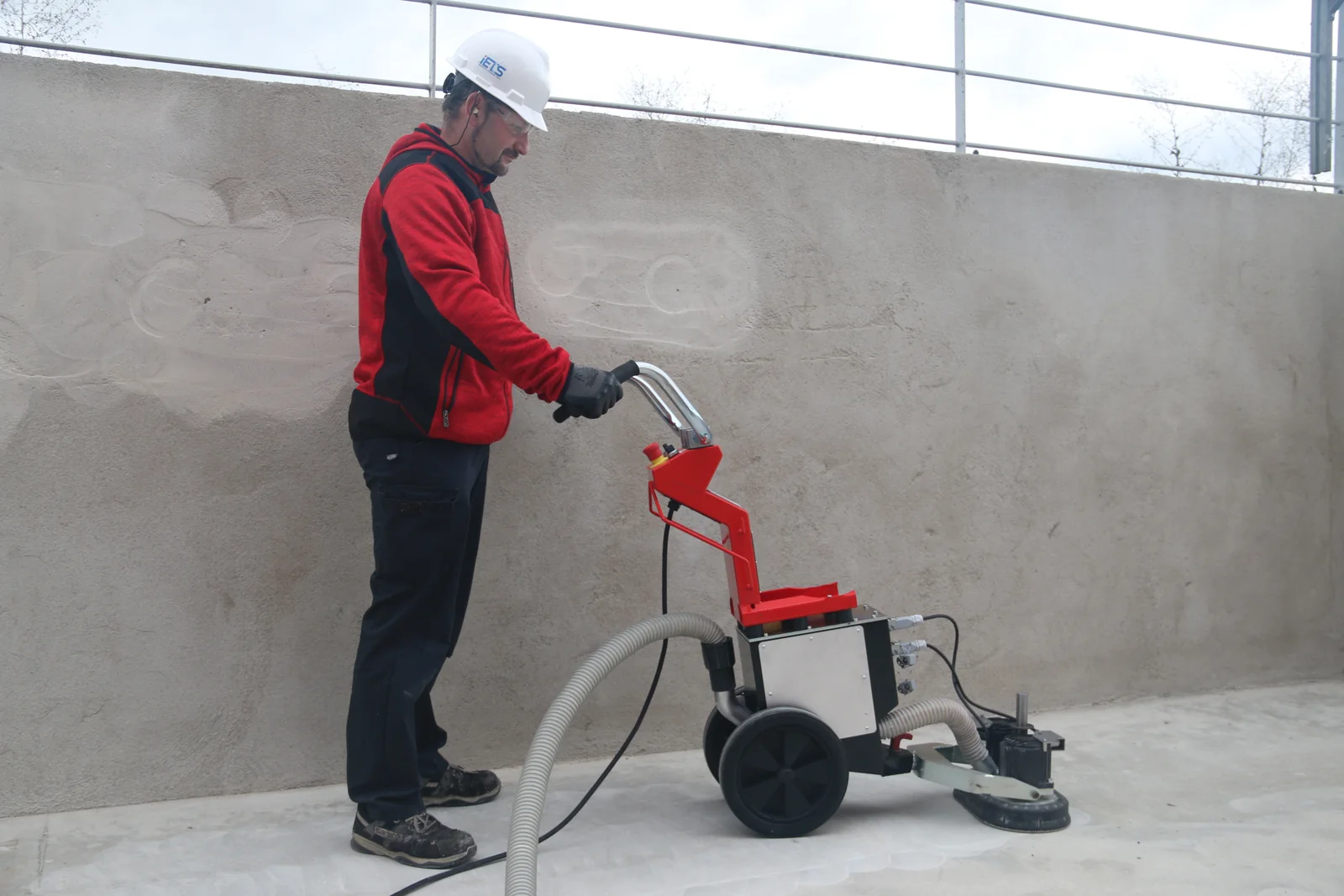
An industrial brushless motor removes the mechanical friction between brushes and commutator, eliminating the main cause of wear in the carbon-brush motor: brushes to replace regularly and a commutator to resurface. This friction generates heat, wear and permanent maintenance. The motor service life of a carbon-brush motor is 1,500 hours (about 600 hours of use), against 20,000 hours for a brushless (about 10,000 hours of use).
A brushless motor (without brushes) removes this friction. Power is supplied through power electronics that switch the motor phases directly. No carbon brushes, no commutator, no brush holder.
The problem is that designing an industrial brushless (1,600 watts from 500 to 4,800 revolutions per minute, IP65 sealed, resistant to abrasive concrete dust) is not the same thing as fitting a consumer drill brushless. It takes a design office, sized power electronics, industrial bearings and a robust housing. The production cost is structurally higher.
How does assembling in Roanne change the quality of the machine?
Assembling in Roanne on a single site creates a feedback loop between the field and the design office: the engineer who designed the machine is on the same site as the workshop, which makes it possible to correct a defect on the next production batch. The hourly cost of a qualified French operator is higher than that of a Chinese or Turkish operator. That is unavoidable.
What this allows, on the other hand, is a direct feedback loop between the field and the design office. When a machine comes back to after-sales service with an atypical fault, the engineer who designed it is on site. The defect is identified and the improvement is made to the next batch. An offshored manufacturer cannot do that: the feedback is lost in the layers of distribution.
Why does Sept Tools refuse white labelling?
Sept Tools refuses white labelling because it breaks industrial continuity: at an Asian OEM, the motor, the plate or the housing can change silently from one order to the next, making maintenance impossible when the spare parts no longer match the machine. Machine A of brand X and machine B of brand Y sometimes come out of the same Chinese factory, with the same motor, the same plate, the same electronics. The only difference is the plastic casing.
Sept Tools does not follow that logic. Sept Tools machines are assembled in Roanne and repaired in Roanne. No silent substitution from one order to the next: the machine and its spare parts stay consistent over time. This principle of industrial integrity has an immediate cost: it closes off access to OEM economies of scale. It has a long-term benefit: it makes maintenance possible.
Made in France: real cost or real argument?
The question deserves an honest answer. Made in France costs more to produce, that is a reality. But that factor alone does not explain the price gap with an entry-level machine: it is also down to the quality of the components, vertical integration and the absence of the absence of stacked distributor margins.
What Made in France allows beyond price
A measurable French after-sales service: diagnosis within 48 working hours, after-sales quote within 1 to 2 working days. Manufacturing traceability that makes it possible, when a machine comes back to after-sales service, to know which batch produced it and which component was used.
For a professional who uses a tool all year round, these elements matter more than the saving made at purchase.
Does French after-sales service make a concrete difference on the jobsite?
Yes: Sept Tools after-sales service is in-house in Roanne, with no distributor or third-party network in between: diagnosis within 48 working hours, after-sales quote within 1 to 2 working days, and less downtime to compensate for with a replacement machine.
A foreign after-sales service (or one subcontracted to a third-party network) typically implies: shipping the machine to the distributor, diagnosis by the distributor, return to the manufacturer, repair, return to the distributor, return to the customer. During this period, the machine is out of service, the tradesperson has to rent a replacement or reorganise their jobsite.
Sept Tools after-sales service is in-house in Roanne. The machine arrives by carrier, it is diagnosed within 48 working hours, the quote is sent, the part is refitted, the machine leaves again. The after-sales quote is announced within 1 to 2 working days, with no intermediary network to go through.
The argument is financial.
Want to put figures on your own case?
If you already use a fleet of grinders, planers or chasers, you can compare the real cost of your current situation with the TCO calculator: your maintenance invoices, your documented jobsite downtime, your replacement cycles.
Request a personalised TCO comparison
Why is white labelling a trap for the professional buyer?
White labelling is a trap because the product can be silently substituted from one order to the next: the OEM manufacturer changes motor, plate or housing supplier without warning the buyer, and the part that fitted the 2022 machine no longer exists in 2024. White labelling (rebranding) consists of a distributor buying a machine from an OEM manufacturer (generally Asian) and putting its logo on it. This practice dominates the entry-level and mid-range lines of most professional DIY chains. It has five consequences for the buyer.
One. The product can be silently substituted from one order to the next. The OEM manufacturer changes motor, plate or housing supplier. The logo stays the same, the machine changes. The buyer is not informed.
Two. Spare parts follow this drift. The part that fitted the 2022 machine no longer exists in 2024. The repairer finds nothing. The machine is thrown away.
Three. After-sales service is subcontracted. The distributor refers to the wholesaler, who refers to the OEM manufacturer, who sends the machine back. And sometimes the machine is not repaired but replaced by a slightly different equivalent, without explanation.
Four. R&D disappears. Nobody improves the machine. Nobody fixes its teething defects. The 2025 machine is, at best, identical to the 2020 machine, at worst slightly worse because the OEM cut corners on components.
Five. The integrity of the brand is diluted. The logo becomes a commercial label, not a technical promise. The buyer can no longer reason on the brand, only on the batch.
Sept Tools refuses this model. It is more expensive to produce, and it is irreplaceable in after-sales service.
And if you are a rental company rather than an end buyer?
The arguments developed in this article take on an extra dimension for a rental fleet, where machine rotation is much more intense. The construction equipment rental page details what Sept Tools brings to rental fleets.
Can the extra purchase cost be funded?
Depending on the equipment, the purchase may be fundable under conditions, subject to prior approval by your insurance fund before purchase. Sanders are not currently in the specification of the Ergonomic risk prevention subsidy: have eligibility validated by your CARSAT before placing any order.
Our guide to public schemes describes each scheme and its exclusions.
Too expensive, too heavy, too bulky: the objections addressed frankly
Three phrases come up at every jobsite demonstration and every first quote. They deserve to be addressed head-on, with verifiable figures and not moral arguments.
Too expensive
This is the most frequent objection, and the one this article develops from start to finish. To sum up: the purchase price is only part of the real cost of a construction tool in intensive use. The rest is concentrated in maintenance, jobsite downtime, replacement rental and residual value. A Sept Tools brushless motor lasts thirteen times longer than a carbon-brush motor on a motor-only basis (20,000 h against 1,500 h), sixteen times longer in use (10,000 h against 600 h). We do no white labelling: the machines are assembled and repaired in Roanne. The purchase price is not the relevant indicator for intensive professional tooling.
Too heavy
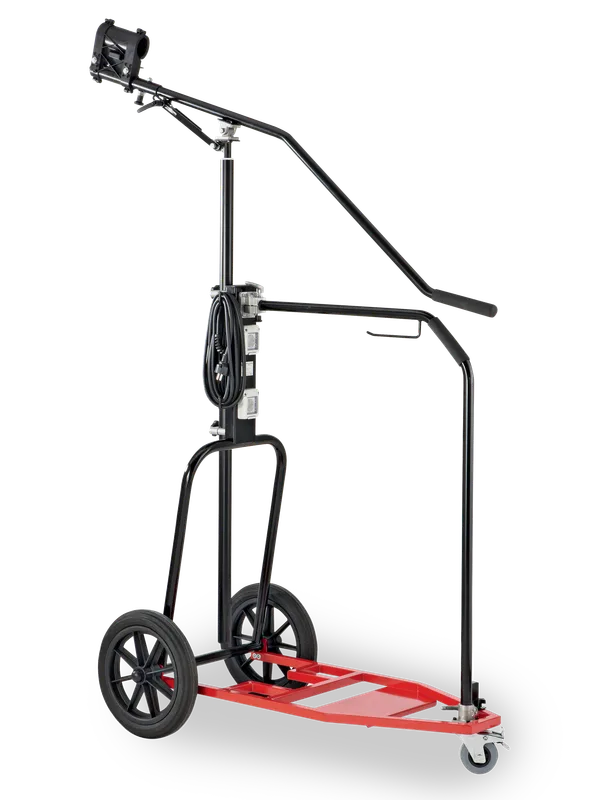
This objection generally comes from buyers who have tried a poorly balanced entry-level giraffe sander, or who judge a machine by its scale rather than by its behaviour at work. The hand-arm vibration declared in the manuals of our sanders ranges from 0.27 to 0.35 m/s² depending on the machine. The declared sound level ranges from 59 to 64 dB(A) depending on the machine. Strain-reduction solutions (balancer, gantry, exoskeleton) reduce carrying effort. The gross weight of the machine says nothing about the weight felt eight hours later.
Too bulky
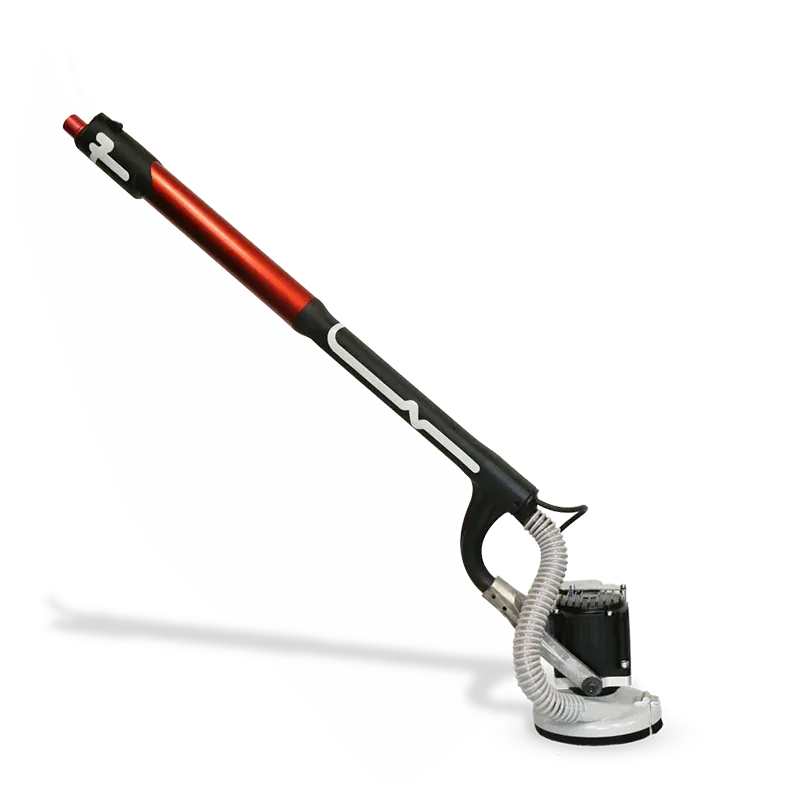
A Sept Tools brushless ceiling sanding set consists of a 1,600 W motor, a telescopic arm, an H-HEPA vacuum and its consumables. Taken separately, each element fits in a standard van. Assembled, the set can be dismantled on site with the supplied spanners. The motor housing is protected IP65, i.e. resistant to dust and water splashes. Stability during work comes from the telescopic arm, not from the overall mass of the machine: we favour mechanical balance rather than adding kilos to compensate for a design flaw.
Calculate the real cost of your fleet over 5 years
The purchase price says nothing about the real cost of a construction tool. Enter the size of your fleet, your hours of use and your team hourly cost: the calculator gives you the cumulative gap over 5 years in a few seconds.
Conclusion
A Sept Tools machine costs more to buy. That is factual, and we stand by it. But the purchase price is not a relevant indicator for intensive construction tooling. The real cost is measured over the full service life, taking into account maintenance, jobsite downtime, the quality of after-sales service and the industrial stability of the brand.
On these terms, paying more for a French brushless without white label is a rational economic trade-off.
Sept Tools Configurator
Find your set in 2 minutes
Guided questionnaire: grinder, vacuum and anti-fatigue accessories matched to your jobsite.
What operators face on site
Comparing on the wrong indicator
The buyer compares catalogue prices without factoring in service life, maintenance and jobsite downtime. The cheapest tool at purchase becomes the most expensive over three years.
Reason in total cost of ownership (TCO) over five years. Include the carbon brushes, unplanned stoppages, the cost of replacement rental, the residual value.
Underestimating carbon-brush maintenance
Brushes are wear parts to be replaced regularly, not counting the time the machine is out of service.
A brushless motor has no brushes to replace; the routine upkeep described in the manual still has to be planned, and can be.
Accepting white labelling
White labelling makes maintenance impossible at three years. The parts change, the motor changes, nobody knows what is inside the machine.
Sept Tools does not do white labelling: the machine and its spare parts are tracked in Roanne.
Free guide: 5 mistakes that shorten the life of your grinder
8 pages of practical tips for your job sites.
Frequently asked questions
Why does a Sept Tools sander cost more than an entry-level sander?
Is Made in France only a marketing argument?
What does a brushless motor change in practice for a professional?
Why don't you do white labelling like most manufacturers?
Why does anti-strain brushless construction tooling cost more?
The premium for anti-strain brushless construction tooling is read against prevention bodies (Carsat, OPPBTP, Ademe) and the thresholds of directive 2002/44/EC. Official reference sources.
 Carsat (Assurance Maladie - Risques professionnels)Official source
- OPOPPBTPOfficial source
 AdemeOfficial source
 Directive europeenne 2002/44/CE (vibrations)Official source
Sept Tools cites these bodies and programmes for information only. Their mention implies no partnership, affiliation or endorsement by them. Always check the current terms on their official websites.
Find your set
Configure your machine + ergonomics + vacuum combination in a few clicks.